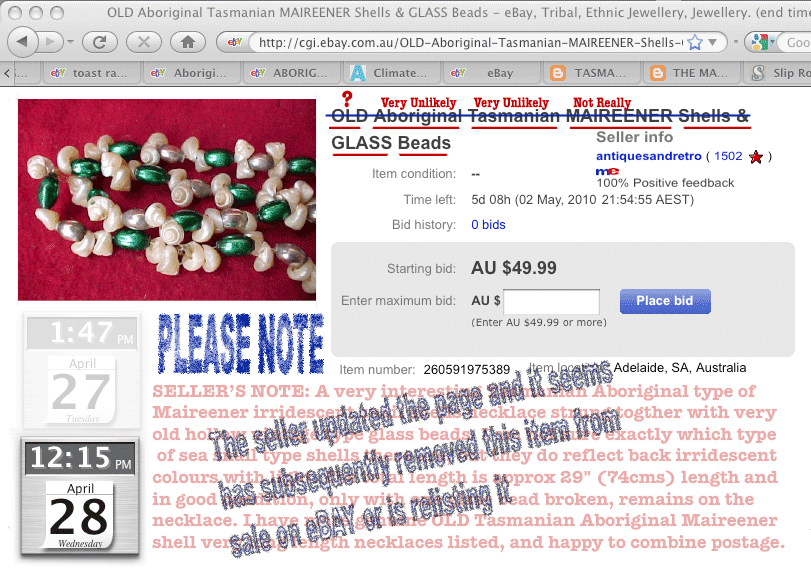
SELLER'S DESCRIPTION: Item N0. 380338511035
"Antique 1900s Tasmanian Maireener Shell Aboriginal Necklace Purple
This wonderful Guaranteed Antique 1900s Tasmanian Maireener Shell Aboriginal Necklace in the rare Purple Iridescent colour is a brilliant example of such shell necklaces. The shells are a wonderful lustrous iridescent purple colour and are in exquisite condition with only a very few missing their points. The shells are well strung on a fine purple silk string and measure 42 cm (overall 168 cm if a single line).
Unfortunately my pictures do not capture the beautiful iridescent glow of these shells. I am loathe to sell this piece but believe it should be in the hands of a real collector for its colour rarity and age.
Please study the array of photos as they are part of the description and ?show the wonderful condition, patina and character better than I can ?explain. Measures: 42 cm long (quadrupled) and 188 cm (single line), shell size approximately 1cm Weight: 35 grams."
This wonderful Guaranteed Antique 1900s Tasmanian Maireener Shell Aboriginal Necklace in the rare Purple Iridescent colour is a brilliant example of such shell necklaces. The shells are a wonderful lustrous iridescent purple colour and are in exquisite condition with only a very few missing their points. The shells are well strung on a fine purple silk string and measure 42 cm (overall 168 cm if a single line).
Unfortunately my pictures do not capture the beautiful iridescent glow of these shells. I am loathe to sell this piece but believe it should be in the hands of a real collector for its colour rarity and age.
Please study the array of photos as they are part of the description and ?show the wonderful condition, patina and character better than I can ?explain. Measures: 42 cm long (quadrupled) and 188 cm (single line), shell size approximately 1cm Weight: 35 grams."
SELLER'S DESCRIPTION: Item N0. 380338515166
"Antique 1850s Tasmanian Maireener Shell Aboriginal Necklace Green
This wonderful Guaranteed Antique 1850s Tasmanian Maireener Shell Aboriginal Necklace in the rare Green Mauve Iridescent colour is a brilliant example of such shell necklaces. The shells are the finest and smallest shells I have seen in these type of necklaces and are a wonderful lustrous iridescent green and mauve colour and are in exquisite condition with none missing their points. The shells are well strung on a fine white silk string and measure 62 cm (overall 122cm if a single line).
Unfortunately my pictures do not capture the beautiful iridescent glow of these shells.
I am loathe to sell this piece but believe it should be in the hands of a real collector for its colour rarity and age.
Please study the array of photos as they are part of the description and ?show the wonderful condition, patina and character better than I can ?explain. Measures: 87 cm long (doubled) and 174 cm (single line) shell size approximately 0.3 - 0.5cm Weight: 10 grams"
The seller has not provided, or offered to provide, any evidence that these necklaces are of Tasmanian Aboriginal cultural production. Without such evidence these necklaces cannot be automatically assumed to be "Aboriginal" as claimed in the description.
Sellers who claim "Aboriginality" for these necklaces seem to be attempting to cash in on the premium contemporary Tasmanian Aboriginal makers are winning for their necklaces. If they are indeed Aboriginal cultural products there needs to be evidence/provenance to support the claim.
So buyers looking for Aboriginal cultural production should beware. For more information go to:
"Antique 1850s Tasmanian Maireener Shell Aboriginal Necklace Green
This wonderful Guaranteed Antique 1850s Tasmanian Maireener Shell Aboriginal Necklace in the rare Green Mauve Iridescent colour is a brilliant example of such shell necklaces. The shells are the finest and smallest shells I have seen in these type of necklaces and are a wonderful lustrous iridescent green and mauve colour and are in exquisite condition with none missing their points. The shells are well strung on a fine white silk string and measure 62 cm (overall 122cm if a single line).
Unfortunately my pictures do not capture the beautiful iridescent glow of these shells.
I am loathe to sell this piece but believe it should be in the hands of a real collector for its colour rarity and age.
Please study the array of photos as they are part of the description and ?show the wonderful condition, patina and character better than I can ?explain. Measures: 87 cm long (doubled) and 174 cm (single line) shell size approximately 0.3 - 0.5cm Weight: 10 grams"
The seller has not provided, or offered to provide, any evidence that these necklaces are of Tasmanian Aboriginal cultural production. Without such evidence these necklaces cannot be automatically assumed to be "Aboriginal" as claimed in the description.
Sellers who claim "Aboriginality" for these necklaces seem to be attempting to cash in on the premium contemporary Tasmanian Aboriginal makers are winning for their necklaces. If they are indeed Aboriginal cultural products there needs to be evidence/provenance to support the claim.
So buyers looking for Aboriginal cultural production should beware. For more information go to:
- Website # 1: http://tasmanianshellnecklaceresearch.blogspot.com/
- Website # 2: http://qvmagstrunghistories.blogspot.com/
- Website # 3: http://truganininecklaces.blogspot.com/