Showing posts with label dyed ?. Show all posts

Saturday, May 15, 2010

eBAY Find – May 2010 UK- maireener shells

CLICK ON THE IMAGE TO ENLARGE
These shells appear to have been dyed which in turn suggests that they are a part of the 'Hobart Necklace' story. Thus far with the dyed – apparently dyed? – shells discovered online the quality of the dye process seems to vary considerably. The sure fire method of determining whether or not a necklace has be dyed is that threading will also be dyed.

That is not the case with "broken necklace" here but that is hardly surprising given that these necklaces are likely to have been restrung many times. The Mawle Report refers to these necklaces being dyed in some cases. Mawle also talks about the variety of quality in shells which in turn suggests that those with 'less disable colouration' were dyed.

Friday, May 14, 2010

eBAY Find – May 2010 USA - maireener shells

CLICK ON THE IMAGE TO ENLARGE

This necklace is honestly described! Clearly the shells are maireener shells and circumstantial evidence for the necklace originating in Tasmania is convincing. The seller does not mention that this necklace may well be dyed or even may not be aware that some such necklaces were dyed with aniline dyes – this one appears as if it may have been to enhance its colouration.

It is clearly an example of the necklaces now known to be of ambiguous authenticity and as likely as not a 20th C exemplar – early to 1930s – of a Hobart Necklace. Given that this necklace is now in the USA it may well have found its way there via Hawaii.

eBAY Find – May 2010 UK- maireener shells


CLICK ON AN IMAGE TO ENLARGE
This is an interesting necklace from a couple of perspectives. Firstly, it is typical of the ambiguous necklaces described as Hobart Necklaces and it almost equally could have made on the Furneax Islands by Tasmanian Aboriginal women. It is clearly Tasmaniana but given that so many of these necklaces are now appearing on the market the veracity of the claims of Aboriginal authenticity is open to challenge.

Many of these necklaces were dyed with aniline dyes and the older examples seemed to have been dyed more subtly/cleverly than those that have turned up and made post WW2. This necklace could well be an example of the older dyed Hobart Necklaces reported on by E. Mawle in 1918. It would be necessary to do a physical chemical test to verify that this necklace had been dyed.

Monday, April 26, 2010

Found on eBAY: Shell Necklaces – Adelaide Aus

CLICK ON AN IMAGE TO ENLARGE
Winning Bid: AU $175.50 13Bids
eBAY#: 260591976842CLICK ON AN IMAGE TO ENLARGE
Winning Bid AU$233.50 29Bids
eBAY #: 260591981036
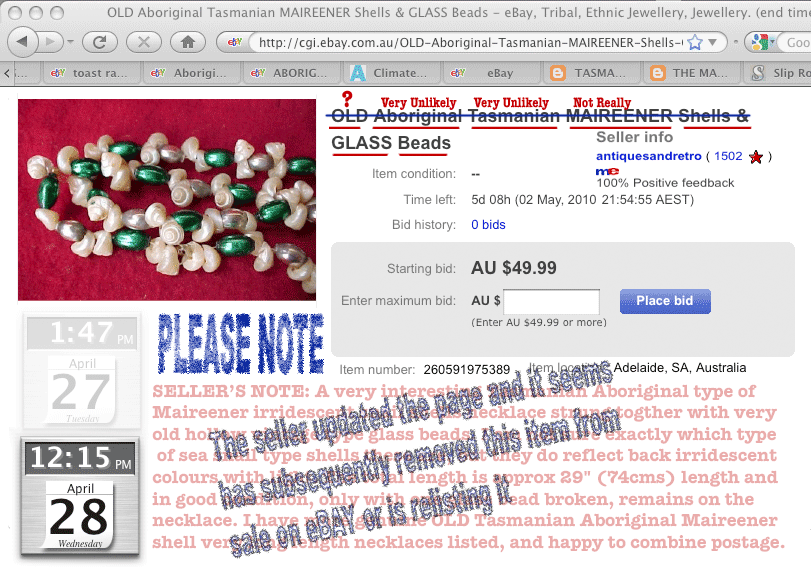
These three listings on eBAY are more interesting together than individually. Looking at the use of the word "maireener" first it seems to be used to invoke 'Aboriginality' but it also seems to have entered the lexicon with the implied meaning 'small irridecent shell for necklace making'.

There is little doubt the true maireener shells did indeed come from Tasmania given that these shells were harvested commercially in Tasmania in the later part of the 19th C up until approx 1960. It is now known that this was not part of the Tasmanian Aboriginal people's cultural production at that time – albeit that they did make shell necklace mimicked by the commercial producers harvesting these shells.

The likelihood of any of these necklaces being made by a Tasmanian Aboriginal maker is very slim. The necklace described a being made of "natural" shell – eBAY #: 260591981036 – may predate the one described as being dyed – this necklace appears to have been dyed also albit more subtly. The former could POSSIBLY have been made by the Martin family's Hobart/Honolulu operation anytime up until circa 1930s. The dyed necklace may have been made by the Bertie May operation in Hobart 1940s >>1960s – eBAY#: 260591976842.

Both could be described as classic Hobart Necklaces.

The necklace with glass beads is quite unlikely to have been of Tasmanian origin EXCEPT in the case that it was made in Tasmania from imported materials and it is known that tropical shells were being imported into Tasmania for the purposes of "shell craft" around the turn of the 20th C – the shells appear to be tropical. Likewise it is highly unlikely that Aboriginal makers had anything to do with this necklace.

Therefore the authenticity of these necklaces must be regarded as being quite ambiguous.

Saturday, April 24, 2010

eBAY Find – April 2010 UK

CLICK ON THE IMAGES TO ENLARGE


This necklace opens up some interesting areas of speculation. If it turns out that shells are identifiable as Tasmanian it may be linked to the necklace depicted in the 'Butterfield Photograph' [ link 1 ] • [ link 2 ] and if it is it may tell us something more about 'Hobart Necklaces' in Tasmania. If the shells can be identified as coming from the UK as implied by the seller here it may tell us something about the trade Hobart Necklaces were a part of.

Watch this space!
Alerted by: PD-SB.US

Thursday, January 7, 2010

eBAY Find – Jan 2010 UK - maireener shells

CLICK ON AN IMAGE TO ENLARGE
SELLERS NOTE: I believe this to be a childs necklace as it is only 12ins long with the brass push in fastener but the shells are beautiful a light iridiscent creamy green with purple .the shells are in good condition with tiny chips on about six shells. A rare and beautiful treasure