Showing posts with label dyed. Show all posts

Friday, May 13, 2011

ON eBAY May 2011: "Antique Tasmanian Maireener Shell Aboriginal Necklace"


SELLER'S DESCRIPTION: Item N0. 380338511035
"Antique 1900s Tasmanian Maireener Shell Aboriginal Necklace Purple

This wonderful Guaranteed Antique 1900s Tasmanian Maireener Shell Aboriginal Necklace in the rare Purple Iridescent colour is a brilliant example of such shell necklaces. The shells are a wonderful lustrous iridescent purple colour and are in exquisite condition with only a very few missing their points. The shells are well strung on a fine purple silk string and measure 42 cm (overall 168 cm if a single line).

Unfortunately my pictures do not capture the beautiful iridescent glow of these shells. I am loathe to sell this piece but believe it should be in the hands of a real collector for its colour rarity and age.

Please study the array of photos as they are part of the description and ?show the wonderful condition, patina and character better than I can ?explain. Measures: 42 cm long (quadrupled) and 188 cm (single line), shell size approximately 1cm Weight: 35 grams."

SELLER'S DESCRIPTION: Item N0. 380338515166

"Antique 1850s Tasmanian Maireener Shell Aboriginal Necklace Green


This wonderful Guaranteed Antique 1850s Tasmanian Maireener Shell Aboriginal Necklace in the rare Green Mauve Iridescent colour is a brilliant example of such shell necklaces. The shells are the finest and smallest shells I have seen in these type of necklaces and are a wonderful lustrous iridescent green and mauve colour and are in exquisite condition with none missing their points. The shells are well strung on a fine white silk string and measure 62 cm (overall 122cm if a single line).

Unfortunately my pictures do not capture the beautiful iridescent glow of these shells.
I am loathe to sell this piece but believe it should be in the hands of a real collector for its colour rarity and age.

Please study the array of photos as they are part of the description and ?show the wonderful condition, patina and character better than I can ?explain. Measures: 87 cm long (doubled) and 174 cm (single line) shell size approximately 0.3 - 0.5cm Weight: 10 grams"

The seller has not provided, or offered to provide, any evidence that these necklaces are of Tasmanian Aboriginal cultural production. Without such evidence these necklaces cannot be automatically assumed to be "Aboriginal" as claimed in the description.

Sellers who claim
"Aboriginality" for these necklaces seem to be attempting to cash in on the premium contemporary Tasmanian Aboriginal makers are winning for their necklaces. If they are indeed Aboriginal cultural products there needs to be evidence/provenance to support the claim.

So buyers looking for Aboriginal cultural production should beware. For more information go to:


Monday, June 7, 2010

eBAY FIND: SHONKY PRODUCT

CLICK ON AN IMAGE TO ENLARGE
This eBAY find is at once disturbing and reassuring. Disturbing, in the sense that the seller here has no discrimination and is willing to do anything to attract attention to a shonky product. Reassuring, in so much as pulling all the key word tricks here has failed to win the level of bidding real maireener shells attract – on other occasions like shells have failed to win a bid at all. Clearly, the buyers of these necklaces know what they are looking at and what it is they are looking for. Other sellers could do well to learn from this failed entry.

These shells keep turning up and nobody seems to have worked out just where they are from. The Philippines is the best candidate thus far. They are tropical and not from Tasmanian waters. Tasmanian Aboriginal maireener makers would feel insulted to have this work attributed to them as they take great care about the collection and preparation of their shells. While it is possible that they may have dyed their shells at some time there is no evidence of it – anecdotal, circumstantial or concrete.

Also, the seller dated this necklace at 1860/70 and there is a fundamental problem with this it would seem. It is very likely that this necklace was dyed with aniline dyes but these dyes were not invented until the 1890s. Arriving at a date of manufacture for an object often relies upon intuition but here invention ans aspiration seems to have been the main factors informing the intuition. If you do not know, then it is usually better to say so.

If this seller had done some research (any research?) this description could not have been used and the Internet makes this research very easy to do – simply Google 'maireener' necklace to start.

Sunday, May 30, 2010

eBAY Find – May 2010 UK - maireener shells

CLICK ON AN IMAGE TO ENLARGE

SOLD: 4Bids Winning bid: £170.00 Approx AU $298.14
Clearly this necklace has been dyed and in most other respects bears the hallmarks of a commercially produced 'Hobart Necklace'. The presence of a clasp reinforces this but it is hard to tell from the photographs if this thread is still dyed as it seem s that these necklaces were dyed after stringing. Almost all the circumstantial evidence points to this necklace being a Hobart Necklace and it being quite unlikely for it to have had a Tasmanian Aboriginal maker as is suggested here.

Typically all these necklaces were assumed to be "Tasmanian Aboriginal Shell Necklaces" but now the evidence suggests that where there is no provenance to verify Aboriginal authenticity it is unsafe to assume Aboriginal authenticity albeit that it is made from Tasmanian maireener shells.

Tuesday, May 25, 2010

eBAY Find – May 2010 USA - non-maireener

CLICK ON AN IMAGE TO ENLARGE
SOLD: US $66.00 – Approx. AU $77.866 BIDSThis entry is interesting in respect to it being evidence of the Tasmanian Aboriginal/palawa kani word "maireener" being used as an eBAY key word to attract buyers of iridescent/pearlescent shell necklaces. Here there is no claim that these shells are from Tasmania as has been the case in the past. Neither does the seller claim Aboriginal cultural production as some have.

Clearly, these shells have been dyed as some Tasmanian maireener shells necklaces made as a part of the colonial commercial production were. Indeed this necklaces production may well have been a part of the 'international trade' Hobart Necklaces were. It seems that many of the Tasmanian necklaces turned up in Hawaii and transmogrified into lei to satisfy the tourist trade's demand for shell lei Hawaiian souvenirs cum cultural trophies. Something similar may be the case here.

The source of these necklaces using these shells is unclear but The Philippines is a prime candidate. Certainly these shells do not originate in Tasmanian waters.

NETWORK NOTE: These shells turn up frequently, and probably belong to the Trochidae mollusc family found anywhere in the Indo-Pacific – the ubiquitous "pearled trochus" shells that show up all over ebay. While they are most probably dyed albeit that some shell nacre can be naturally coloured – eg Tasmanian maireeners, the NZ paua shell and others. The difficulty in identifying these shells exactly is because all the exterior identifying characteristics have been stripped away. Numerous species of trochus shells have this same size and shape.
KC & LT

Sunday, May 16, 2010

eBAY Find – April 2010 UK - maireener shells

CLICK ON AN IMAGE TO ENLARGE
These two necklaces turning up as they have together, and in the condition they seem to be in, offers an insight into the Tasmanian shell necklace trade. Given that to date an oral history that suggests Tasmanian Aboriginal makers regularly, or even at all, dyed their shell necklaces has not emerged in turn this indicated that these necklaces may well be commercially produced 'Hobart Necklaces'. Accepting that circumstantially these necklaces are indeed late 19th or 20th 'Hobart Necklaces' there are some interesting observations to be made.

The first being that looking at the examples of 'Bertie May Necklaces' the evidence here seems to point to his necklaces being more intensely, and less subtly, dyed than these necklaces. Given that May was known to be operating in Hobart Late 1940s >> 1960s in Hobart this tends to suggest that these necklace pre-date WW2.

Given Earnest Mawle's report on the shell necklace trade in Tasmania and the dying of maireener shells this tends to date these necklace before WW2. Also, Mawle talks about the disparate quality in shells harvested for 'the trade' and likewise given the evidence for this in regard to the shells turning up in the UK & USA it seems that there may well have been an incentive dye shell with less colourful iridescence. The shells here have clearly been dyed and similarly they may well have been from made using less colourful, whiter , shells – as likely as not 'harvested' on the Tasman Peninsular.

Monday, April 26, 2010

Dyed maireener Necklace

This necklace is entirely as described and no claims were made for that could not be substaniated. There are two obvious options for its origin. The first being the Hobart souvenir trader Bertie May who is known to have produced dyed necklaces such as this. He was active 1940s>>1960. The other option being a maker linked to the Martin family who started producing shell necklaces in Hobart in 1875 and were known tom be trading in 1927.

Earnest Mawle's Report of 1918 is a key reference that contextualises to some extent the 'industry' that produced Hobart Necklaces. Mawle's report refers to the dying of shells. There is beginning to be increasing evidence that Bertie May's production may be able to be distinguished from the dyed shell necklaces of producers/marketers like the Martins.

May's dyeing seems to be more intense in its colouration while necklaces that seem to be older than his are less intense and somewhat more subtle. There is no evidence that Tasmanian Aboriginal makers dyed their shells but it cannot be dismissed out of hand. On the balance of probability, this example seems to be older than May's production and more likely to be of non-Aboriginal production than Tasmanian Aboriginal.

Like all such necklaces there is quite a bit of ambiguity about this example.

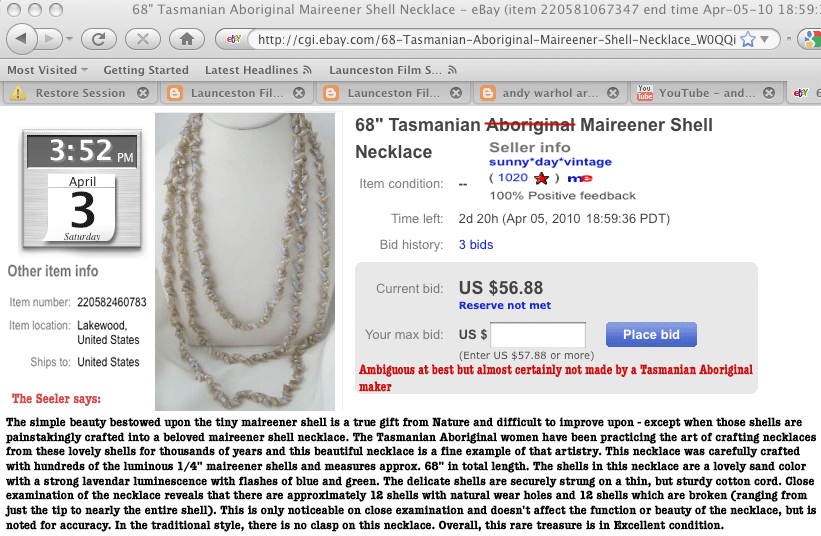
Saturday, April 3, 2010

eBAY FIND- April 2010 USA - maireener shells


NOTE: The necklace above has been relisted and redescribed removing the word "Aboriginal" from the title and description. This reflects the ambiguity of the piece and indeed it may well be a Hobart Necklace circa early 1900s and even one that found its way to the USA via Honolulu.

These finds are continuing evidence that a great many of these necklaces were made and many more than there are likely to have been Tasmanian Aboriginal makers to produce them. – albeit that there were clearly some. It is unclear how the necklaces made as "Hobart Necklaces" in the late 1800s and early 1900s came to be understood as "Aboriginal Shell Necklaces".

eBAY is most likely the vehicle via which the word maireener (the Tasmanian Aboriginal word for the shells and sometimes the necklaces made from them) has entered the 'global' lexicon for these particular shells and seemingly increasingly used by default for all small iridescent shells used for necklace making – Tasmanian & other.

They are also evidence of the global carelessness for the cultural cargo "Tasmanian Aboriginal Shell Necklaces" carry. This is so even though it is increasingly clear that the Hobart Necklaces are blatant mimics of their 'Aboriginal prototypes'. Unless "Aboriginal" carries some kind of cultural cargo that adds value to the necklace it is difficult to explain why these mimics so readily win 'quasie Aboriginal status'.