Showing posts with label USA.. Show all posts

Saturday, May 14, 2011

Highly Unlikely To Be As Described

Click on the image to enlarge

This item is highly unlikely to be what it claims to be and possibly yet another exemplar of an online seller invoking 'the Aboriginal Factor' in order to win a premium. Well typically it doesn't work because buyers tend to do their research and know about the things they collect.

The lack of bids here says most of what needs to be said.

Monday, June 21, 2010

eBAY Find – June 2010 USA - maireener shells

SELLER'S NOTES:
  • #2_ Vintage Tasmanian Maireener Shell Lei Necklace Iridescent Pink
    This is a beautiful vintage Tasmanian Maireener Shell lei necklace. The shells are strung on thread. I do not know if these shells were dyed [almost certainly they have been] or not, but they awesome shades of iridescent pink and blue green colors ... It is in excellent condition and I do not see any broken or missing shells. It measures approximately 34 inches long from end to end ... SOLD FOR: US $152.49 = Approx.AU $175.32
  • #3 _Vintage Tasmanian Maireener Shell Lei Necklace Iridescent White
    This is a beautiful vintage Tasmanian Maireener Shell lei necklace. The shells are strung on thread. I do not know if these shells were dyed or not, [unlikely to have been]but they awesome shades of iridescent blue green colors ... It is in excellent condition and I do not see any broken or missing shells. It measures approximately 34 inches long from end to end.... SOLD FOR: US $149.99 Approx. AU $172.44
  • #1 _ SOLD FOR: US $247.50 Approx. AU $284.55
The most interesting thing about this eBAY sale is that these maireener shell necklaces were described as they were ... "Vintage Tasmanian Maireener Shell Lei Necklace " ... They seem to have come to the seller's possession via West Coast USA sources and it is possible that one way or another the Hawaiian links have been subliminally made.

Authentic Vintage Hawaiian Niihau Shell Lei Necklace

SELLER'S NOTE: Authentic Vintage Hawaiian Niihau Shell 4 Strand Lei Necklace
"This is a beautiful vintage authentic Hawaiian Niihau Shell four strand lei necklace from the island of Niihau. From what I have read, it is made from Mitrella Margarita shells and has a clasp that is made out of two shells that are Cypraea (Staphylaea) granulata granulate, Common Name: Granulated Cowry, Hawaiian Name: Poloholoho'ãpu'upu'u and the two shells where all 4 strands are tied together are Common Name: Depressed/Variegated Sundial, Hawaiian Name: Kauno'o ... There is an old brass sewing snap for the actual closure hook. This snap was glued to the back of the Cowry shells and works perfectly. One of the Cowry shells has a spot that has worn through and shows the natural pink shade of the shell (see photo). This is not a chip; it was worn by the ocean ... It is in excellent condition and I do not see any broken or missing shells. It measures approximately 26 inches long from end to end.

I am listing a beautiful collection of shell leis and necklaces. Some are very rare hard to find extinct shells. If you’re a shell or shell jewelry collector, this is an awesome opportunity to add to your collection. Good luck and Happy Ebaying!"
•••
It seems that Tasmanian maireener shell necklaces that found their way to Honolulu via the 'M M Martin' enterprise – and perhaps via other makers/suppliers as well – became part of the Hawaiian tourist trade market for 'lei' and possibly even used by Hawaiians as lei. This lei seems as if it may be a good example of what they were intended to mimic.

Monday, June 7, 2010

Found on eBAY: USA - maireener shells

CLICK ON AN IMAGE TO ENLARGE
Ended: 14 June, 2010 – 10:13:24 AEST – 14 bids
Winning bid:US $292.00 – AU $343.85
This necklace is typical of the necklaces that have ambiguous authenticity and circumstantially becoming less likely to be made by a Tasmanian Aboriginal maker. Here again there is the use of 'maireener' as an eBAY key word to bring these necklaces to the attention to eBAY buyers who are now paying more attention to them. This necklace seems to be of natural colour and at the same time of a colour type that it seems was sometimes dyed.

Tuesday, May 25, 2010

eBAY Find – May 2010 USA - non-maireener

CLICK ON AN IMAGE TO ENLARGE
SOLD: US $66.00 – Approx. AU $77.86 – 6 BIDSThis entry is interesting in respect to it being evidence of the Tasmanian Aboriginal/palawa kani word "maireener" being used as an eBAY key word to attract buyers of iridescent/pearlescent shell necklaces. Here there is no claim that these shells are from Tasmania as has been the case in the past. Neither does the seller claim Aboriginal cultural production as some have.

Clearly, these shells have been dyed as some Tasmanian maireener shells necklaces made as a part of the colonial commercial production were. Indeed this necklaces production may well have been a part of the 'international trade' Hobart Necklaces were. It seems that many of the Tasmanian necklaces turned up in Hawaii and transmogrified into lei to satisfy the tourist trade's demand for shell lei – Hawaiian souvenirs cum cultural trophies. Something similar may be the case here.

The source of these necklaces using these shells is unclear but The Philippines is a prime candidate. Certainly these shells do not originate in Tasmanian waters.

NETWORK NOTE: These shells turn up frequently, and probably belong to the Trochidae mollusc family found anywhere in the Indo-Pacific – the ubiquitous "pearled trochus" shells that show up all over ebay. While they are most probably dyed albeit that some shell nacre can be naturally coloured – eg Tasmanian maireeners, the NZ paua shell and others. The difficulty in identifying these shells exactly is because all the exterior identifying characteristics have been stripped away. Numerous species of trochus shells have this same size and shape.
KC & LT

Tuesday, May 18, 2010

Call For Shell Identification – maireeners??

CLICK ON THE IMAGE TO ENLARGE
The image above was sent in to the network in search of identification "of a shell necklace I have acquired- it is very long and worn lariat style ... there is a close up of the shells - the necklace is made up of hundreds of these shells ... I have been told they are [Tasmanian] maireener shells ... would you be able to confirm this at all ... SD_P1020075 "

Clearly the owner here has been mislead and these shells ARE NOT remotely like any of the shells now being marketed on eBAY or anywhere else as 'Tasmanian maireener shells'. However it has been noted that 'maireener' is being used to describe a range of small iridescent shells – not always from Tasmania if at all – used to make necklaces. The shells that do qualify for being called maireener shells are identified here – click here. Given that these shells are not Tasmanian – and even unlikely to be Australian – we are not in a position to say what they actually are but there are network members who may be able to.

It is most important to remember that maireener shells are only iridescent if they have been cleaned – had their outer coating removed either chemically or physically.

If the owner bought these shells because they were maireeners shells, or even Tasmanian maireener shell, or worse still Tasmanian maireener shells in a Tasmanian Aboriginal made necklace they have been mislead. The word 'maireener' has become "the key word" for the necklaces that are recorded on this site.

It has been noted that 'maireener' has often been misused as a key word by eBAY sellers!

Well here is the information requested: "These are a prosobranch (gilled) landsnail. The Family is Helicinidae. Exact species is difficult to pin – they look alot alike – but likely genera are Helicina, Sulfurina, or Orobophana. There are many species in the West Indies and tropical Asia, including islands in the Pacific ... one species has been identified in Texas, USA. On eBay, sometimes they are listed as 'pikake' shells, which possibly is not accurate, either. Several "Hawaiian" necklaces contain these shells. Sometimes they are coated with a pearlized-looking paint to make them appear iridescent, but they do not contain any mother of pearl and are therefore incapable of being truly iridescent. They are kind of cute and string nicely." ... the knowledge bank grows.

Friday, May 14, 2010

eBAY Find – May 2010 USA - maireener shells

CLICK ON THE IMAGE TO ENLARGE

This necklace is honestly described! Clearly the shells are maireener shells and circumstantial evidence for the necklace originating in Tasmania is convincing. The seller does not mention that this necklace may well be dyed or even may not be aware that some such necklaces were dyed with aniline dyes – this one appears as if it may have been to enhance its colouration.

It is clearly an example of the necklaces now known to be of ambiguous authenticity and as likely as not a 20th C exemplar – early to 1930s – of a Hobart Necklace. Given that this necklace is now in the USA it may well have found its way there via Hawaii.

Saturday, May 8, 2010

eMAIL Alert: maireener shell necklace collection via eBAY & Western Australia

CLICK ON AN IMAGE TO ENLARGE


CLICK ON AN IMAGE TO ENLARGE

JW6710, the eBAYER here, brings some special knowledge to this collection, namely qualifications and experience as a jewellery designer. The fact that she operates from an out of the way place says something about contemporary cultural production and the unlikely places eBAY reaches.

JW6710 has supplied these images of a sample of her collection not only as a demonstration of what can be found on eBAY but also the diversity of maireener shell necklaces. From all accounts these necklace come 'provenance free' and one assumes these items come to light via clearance sales, estate auctions and the like. Apparently they are kind of things that hang around in bottom drawers as memoirs of the past and far too precious to throw away – albeit that very often they are sold for very little.

NECKLACE # 6: The circumstantial evidence is that all of these shell necklaces are quintessentially Tasmaniana but their 'cultural context' is nonetheless ambiguous. All but #6 are typical of the maireener necklaces turning up that bear all the hallmarks of being 'Hobart Necklaces'. The #6 necklace is somewhat curious in that it is made using juvenile shells which in turn would mean that the effort in stringing is considerably more than 'the typical Hobart Necklaces'.

Extrapolated from this are the facts that given that commercially harvested shells were paid for by the quart they may well have been less attractive to harvest. Also, given the additional number of shells in a necklace they would be more time consuming to string. If payment for stringing was paid by the piece these necklaces may have been more expensive. Earnest Mawle's report 1918 makes no mention of the use of juvenile shells – this does not by necessity discount their use in Hobart Necklaces however.

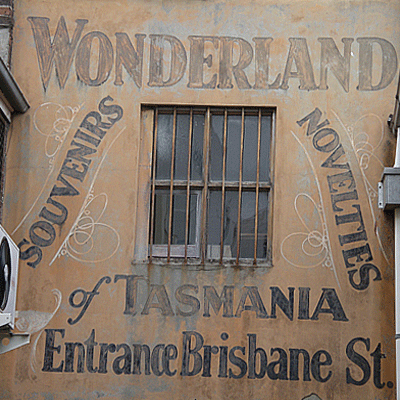
In Launceston in the 1940s/50s maireener necklaces made with juvenile shells were available and circumstantially it seems that these necklaces were sourced in the Bass Strait Furneax Islands rather than Hobart – and say the Bertie May operation. Albeit speculative, there is a first hand reports of necklaces made with juvenile shells being purchased at Wonderland Brisbane St. Launceston 1940s and circumstantially these necklaces are most likely to be of Aboriginal production on the Furneax Islands.

Thank you JW6710 for sharing a part of your collection!

Friday, May 7, 2010

eMAIL Alert: maireener shell necklace via eBAY & Western Australia

CLICK ON THE IMAGE TO ENLARGE

This necklace was bought via eBAY, from USA and it came with with no history or provenance. The owner trades on eBAY, lives in Western Australia and has inquired of some eBAY sellers who have said that "the GIs coming back from the islands WW2, bought back all sorts of shell necklaces with them."

The owner – a professional jeweller and collector of maireener shell necklaces – says that this necklace is dyed and that would make it consistent with the Mary Martin Necklaces circa 1900 to 1920s. Also, it may well be consistent with the necklaces that were exported to Hawaii from Tasmania around the turn of the 20th Century by the Martins.

This necklace may also have been made in Honolulu at the Martin's operation there using shells imported from Tasmania and local labour. The shells are clearly Tasmanian and given the paucity of concrete information and the growing number of options, the necklace is the quinessentual exemplar of the ambiguous maireener shell necklace. Here, Tasmanian Aboriginal production seems highly unlikely however.

Later necklaces were dyed but it seems that with the 'older examples' the dying was more subtle than with those made post WW2 in Tasmania. This example would appear to be older than post WW2 necklaces.

If this stringing is 'original' it is consistent with the kind of way some Hawaiian shell lei are strung and it may have been produced by the Martin family either in Hobart or Honolulu for the Hawaiian market.

Saturday, April 3, 2010

Found on eBAY: USA - maireener shells

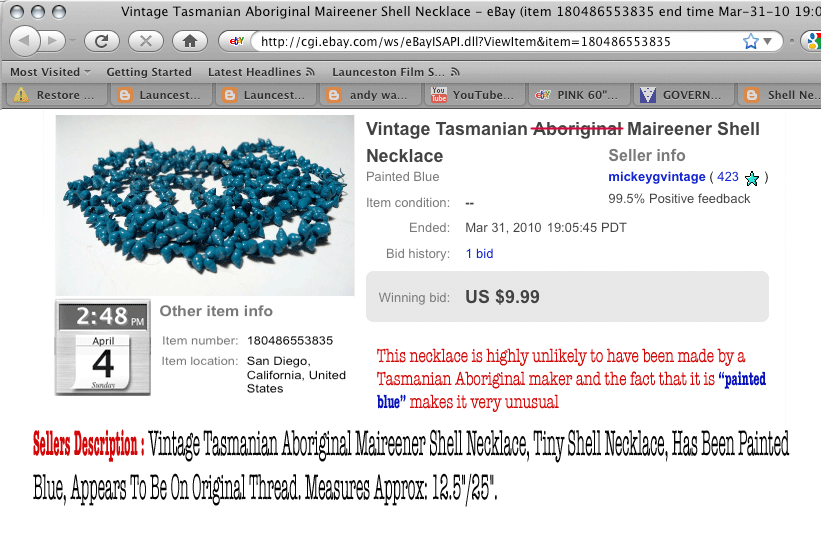
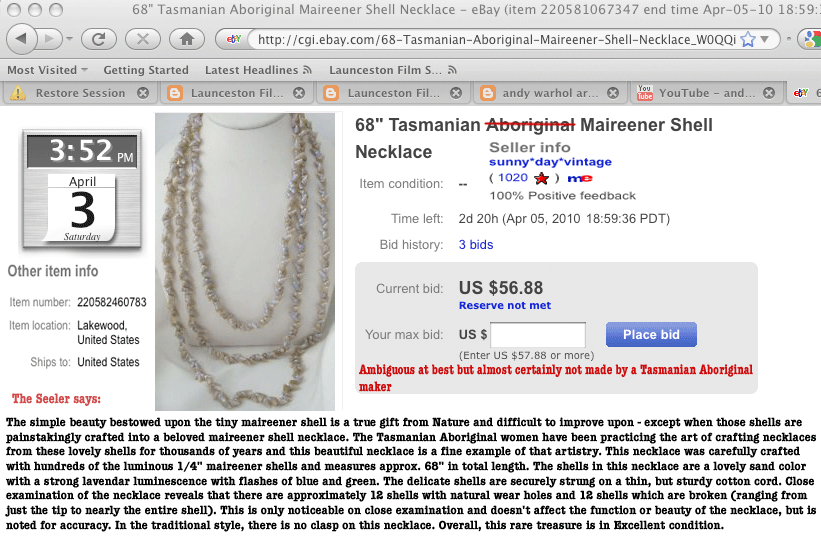
Clearly the only thing that is credible about this necklace is that it is described as having been painted. It may be of 'Tasmanian origin' but that is unlikely and almost certainly it is not of Tasmanian Aboriginal cultural production – contemporary or vintage. The shells may well have originated in Tasmania but that does not by itself imply Aboriginal cultural production.

eBAY FIND- April 2010 USA - maireener shells


NOTE: The necklace above has been relisted and redescribed removing the word "Aboriginal" from the title and description. This reflects the ambiguity of the piece and indeed it may well be a Hobart Necklace circa early 1900s and even one that found its way to the USA via Honolulu.

These finds are continuing evidence that a great many of these necklaces were made and many more than there are likely to have been Tasmanian Aboriginal makers to produce them. – albeit that there were clearly some. It is unclear how the necklaces made as "Hobart Necklaces" in the late 1800s and early 1900s came to be understood as "Aboriginal Shell Necklaces".

eBAY is most likely the vehicle via which the word maireener (the Tasmanian Aboriginal word for the shells and sometimes the necklaces made from them) has entered the 'global' lexicon for these particular shells and seemingly increasingly used by default for all small iridescent shells used for necklace making – Tasmanian & other.

They are also evidence of the global carelessness for the cultural cargo "Tasmanian Aboriginal Shell Necklaces" carry. This is so even though it is increasingly clear that the Hobart Necklaces are blatant mimics of their 'Aboriginal prototypes'. Unless "Aboriginal" carries some kind of cultural cargo that adds value to the necklace it is difficult to explain why these mimics so readily win 'quasie Aboriginal status'.

Thursday, January 7, 2010

eBAY FIND- Jan 2010 USA - maireener shells


CLICK ON THE IMAGE TO ENLARGE

SELLER'S NOTE: This is an incredible delicate micro maireener shell necklace … My pictures do not do the necklace justice in the shimmering opalescent greens & purpilish pinks these were made in the late 1800's early 1900's by the aboriginal palawa people of Tasmania these lovely shells are quite scarce now and hard to find. These shells are dainty and all measure under .25 of an inch long. I found about 5 damaged shells that to not take away from the value of the piece and it took some long looking to even find them EBAY LINK # 360224009124